I have been exactly
where you are now.
Working hard, trying to show up for everyone, doing my best to hold it all together. And quietly, privately struggling with my weight and my health for over two decades. Until I finally figured out what actually works for sustainable weight loss and health transformation as a woman over 40.
This is not a story about weight loss. It is a story about what it costs you to live in a body you are quietly at war with, and what becomes possible when you finally stop fighting and start understanding.
I know what it is to be working hard at your career, trying to show up for your relationships, doing your best to hold everything together, and to carry a private struggle that has nothing to do with any of it. To spend enormous amounts of invisible energy managing what people see. Which photos you allow. Which chair you choose. What you wear to cover your arms rather than because you love it. Which angle you stand at in a group shot so you can take up a little less space.
"The most exhausting thing I ever did was pretend I was fine with it. Fine with being heavier than I wanted to be. Fine with the everyday indignities of it. Fine with all of it. I wasn't fine. Not even close."
I used to think that accepting yourself as you are now and genuinely wanting to change were completely at odds with each other. That you had to choose one. Now I know that is not true at all. Real self-acceptance is exactly what makes lasting change possible. Not shame. Not punishment. Not someone else's rules. Self-respect, turned into standards you actually want to live by.
Everything I share comes from having been where you are. And I want you to know that the other side of this is real, reachable, and so much better than just surviving.
From athlete to a demanding desk career, and the weight that arrived quietly and stayed.
I grew up playing competitive tennis. I was on the varsity team in junior high, competing a year or two ahead of my age group. Then I spent nearly four years training at the Nick Bollettieri Tennis Academy in Florida, the same courts that shaped Andre Agassi, Maria Sharapova and Serena Williams. It was serious, structured, identity-defining training.
But injuries ended that chapter. I left Bollettieri, transferred to a different high school, joined their varsity tennis team and eventually became co-captain and their star player. And then the sport I had built my entire identity around was simply over. My athletic self was gone. And with it went the structure, the movement, the physical confidence that had always just been there.
What followed was two decades of demanding, largely sedentary desk jobs. I earned my degree from the Wharton School at the University of Pennsylvania and then spent years climbing the corporate ladder in finance and banking across New York, Washington DC and London. Working long hours. Eating on the run. Quietly watching my body change in ways I told myself I didn't have time to address.
The freshman 10 that many people know from college? For me it was closer to 40. And those pounds didn't leave when college ended. They just kept accumulating through the long hours, the stress, the business dinners, the travel, the lifestyle of someone who had gone from being a serious athlete to sitting at a desk for twelve hours a day.
And the whole time, I was trying. The diets. The programs. The fresh starts. The meal replacement shakes. The vegan phase. The raw food phase. The calorie tracking apps. The punishing fitness regimes. None of it stuck. And I could not understand why, when I was genuinely, seriously trying, I kept ending up back at the same place.
Maybe you know this feeling. You're not someone who has given up. You have tried, repeatedly and seriously. And still here you are. That was me for over twenty years. And the path out was not what I expected.
75 lbs lost in 6 months. Every pound back. And the part nobody talks about honestly.
In my mid-thirties I lost 75 pounds in six months. Through restriction so extreme it was really just prolonged punishment. I followed other people's rigid rules with the kind of discipline that is genuinely exhausting to maintain. And by every external measure, I succeeded.
And then the weight came back. Not all at once. Slowly, quietly, in the way these things always happen when the method was wrong from the beginning.
"When the weight started coming back on, it didn't feel like failure at first. It felt like freedom. Like exhaling after holding my breath for years. Like being a human being again instead of a machine following a strict set of rules that cut out whole parts of my life and left me exhausted."
The restriction had been so extreme that rebellion was the only honest response. So I ate what I wanted. Lived like someone who had been released from a sentence she hadn't chosen. And for a while, genuinely, that felt good.
And then, slowly, it didn't. The clothes got tighter. I started avoiding the mirror. I stopped stepping on the scale, not because I didn't care, but because I couldn't bear to know. I started declining invitations to see people who had last known me at my slimmest. I became fluent in the calculations that women in this situation learn without being taught: which chair is sturdier, which seat at the table hides the most, which blazer covers the arms, which angle in a group photo makes you smaller, where to stand so you can angle away from the camera.
If you've ever scanned a room for the right chair before sitting down, if you've ever turned away from a group photo, or worn the jacket not because you love it but because it covers, I see you. I have been you. And I want you to know you are not alone in any of this.
I told myself it was a phase. A preference. But I was pulling back from my own life. And it was costing me more than I was willing to admit.
Curious about how I now help women through exactly this? See how I work with women over 40.
There was no single "aha moment"
when it all magically clicked into place.
There were many.
My turning point was an accumulation. Small indignities. Big humiliations. A growing knowledge that I wanted more out of life, out of my body, out of myself. Lying awake wondering if I deserved more, and not quite believing I would ever get there. Here are just four of those moments. You might recognize yourself in them.
The knees. The hiking poles. The bathroom.
At my heaviest, and I genuinely don't know how much I weighed, because I couldn't bring myself to step on a scale, I decided to start running. A few short jogs, nothing extreme. What I didn't realize was that the extra weight was putting so much stress on my knees that it triggered serious flare-ups of old injuries from my tennis years. I ended up unable to get out of bed without assistance. Using hiking poles to walk to the bathroom. For over two weeks. In my early forties. I lay there and asked: if this is now, what does sixty look like? That is why when I say I lost 100+ pounds, I mean it as a real number, not a catchy round figure. I don't know my exact starting weight. It was too painful to know. If you are looking at a mountain that feels impossible to climb, I want you to know I have stood at the bottom of that same mountain. And I am telling you that you can absolutely do this!
The metro. The seat. The young man who meant so well.
A kind young man, probably around my age or a little younger, offered me his seat on the metro. Gently, with complete goodwill. It took me a moment to understand why. And then it landed. He thought I was pregnant. I was not pregnant. I said thank you and I stood. The shame and embarrassment stayed with me for a long time. Not anger at him, he was being kind. But a specific, clarifying awareness that the struggle I had thought was entirely internal was not. Our bodies are external. They affect not just our own confidence and joy but every interaction, every room we walk into. After that I would actively choose where to stand on the metro or bus, making sure I was never near the disabled and pregnant sign. I was terrified of it happening again.
The woman in her eighties. The small dog. The morning walk.
I was walking a route near my home. Ordinary, flat, not demanding, the kind of walk that should feel easy. I was breathing hard with the effort of it, aware of how much work my body was doing just to move. And I was overtaken by a woman who must have been in her eighties, walking her small dog at a pace that was completely, effortlessly comfortable. No effort. No heavy breathing. Just walking. I stopped and watched her go. And I thought, with sudden clarity: she is forty years older than me and this is harder for me than it is for her. That thought was enough.
The photo. And what I realized it was really about.
Someone took a photo of me and showed it to me. I felt a jarring, disorienting jolt. I didn't recognize the person looking back at me. After that I started avoiding photos entirely. Declining to be in them, moving out of frame, making excuses. And when I finally sat with that honestly, I realized it wasn't about photos at all. It was about not wanting to be seen. Not wanting to take up space. And that had started bleeding into everything, the events I didn't go to, the opportunities I didn't take, the version of my life I was quietly stepping back from. I had been making myself smaller and smaller. And I decided that I was done with that.
The part that was hardest to admit.
I am a feminist. I believe every woman has the right to exist exactly as she is, at any size, in any body, without apology. I believe worth is not conditional. I believe we should not shrink ourselves for anyone else's comfort.
And I was not happy. And those two things were in direct conflict with each other in a way that made me feel like a hypocrite for years.
"The thing I could never admit, even to myself, was that I thought I had to earn the right to exist. Through performance. Through achievement. Through how I looked. And somehow, even recognising that thought felt antifeminist, which made it almost impossible to look at honestly."
I knew I felt most confident, most alive, most fully myself, when I was at my healthiest. And admitting that felt like a betrayal. Like I had internalized the very narratives I had spent years rejecting.
But here is what I eventually understood. Wanting to be healthy is not antifeminist. Wanting to feel good in your own body is not vanity. Choosing to change from a place of self-respect rather than self-punishment is not a concession to anyone else's standards. It is, I think, the most feminist thing I have ever done.
There was something else underneath it too. I was watching people around me, colleagues, people I knew and admired, pay the price of having put their health last for too long. Not just heart attacks and strokes, though those happened too. The quieter losses. The person who couldn't travel anymore. The woman who had built everything she wanted and then didn't have the vitality to enjoy any of it. With each passing year I had one more example of what the road I was on actually led to. And I made a decision. Not about how I looked. About the future I was building.
I turned every analytical skill I had ever built
on myself.
I became an entrepreneur. And in that chapter I discovered something my corporate career had never taught me: that pushing harder is not always the answer. That other people's rules, however convincingly packaged, may have nothing to do with your reality. That standards you set for yourself will always outlast rules imposed from outside.
And somewhere in my early forties, during perimenopause, exhausted by decades of trying and struggling and trying again, I stopped looking for someone else's program to follow. I stopped asking what the rules were. And I started asking a different question entirely, the same question I had asked throughout my years in banking and finance.
"What if I cut through all the noise, the conflicting information, the promises, and asked the one question that actually matters: what is genuinely worth investing in?"
The answer was myself. My health. My future. Not the number on a scale. The actual investment in a life I could fully live.
I spent 2.5 years doing that work. Reading the research. Testing things on myself. Discarding what didn't work and keeping what did. Not someone else's program. A methodology built from the inside out, rooted in self-respect rather than self-punishment. I call it the Standards Over Rules Method. You can see one example of what that looks like in practice in my free Sugar Decoder Guide.
The result was 100+ pounds lost. Naturally. Sustainably. Permanently. During perimenopause. Without pills, without injections, without calorie counting, without a single day of hating myself toward health.
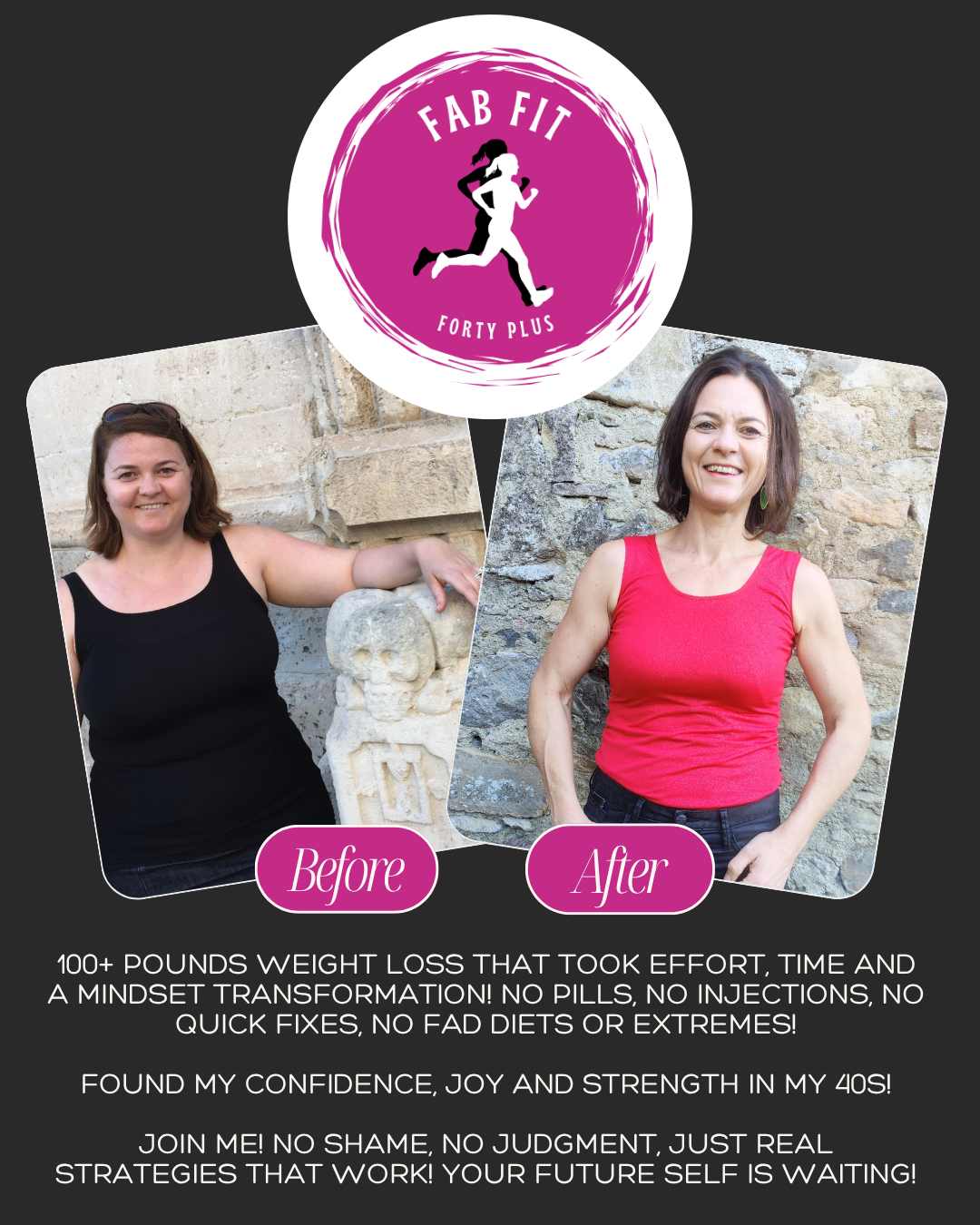
It held. It still holds.
Not the Instagram highlight reel.
The real version.
When people ask what the other side feels like, I am always careful how I answer. The glossy transformation version of this story, the confidence, the energy, the before and after, is true. But it leaves out the parts I think are most useful to hear.
I no longer calculate which chair is safe before I sit down. The armrests no longer dig into my hips. I no longer wonder whether it will hold.
I can eat a burger or a slice of pizza or a piece of cake in public without the heavy awareness of being watched and judged. If you've ever been overweight and eaten something like that in front of people, you know exactly what I mean.
The emotional energy I spent every single day on shame management, the calculations, the avoidances, the performances, is now free for the things that actually matter. That shift has changed my life more than any number on a scale ever could.
I can enjoy a holiday, eat freely, live fully, and come back to my standards without drama or terror. The fear of the slippery slope, of waking up and realising everything has crept back, is simply gone.
I love myself now, not because of the number on the scale, but because of the effort, the honesty and the integrity of the approach. Because I showed up for myself, consistently, imperfectly, honestly. And I continue to do so. Every single day.
I am excited about the future. Not managing it or quietly dreading it. Genuinely excited. Because this body will carry me forward, into my 50s, 60s and beyond, with strength, presence and joy.
Yes, I want you to reach your weight loss goals. I absolutely want that for you. But what I want most is something bigger than a dress size or a number on a scale or anyone else's idea of what your body should look like.
What I want most for you is the exhaustion gone. The shame gone. The emotional energy returned and invested in your actual life. The future opened back up. And the version of yourself that has been waiting, given permission to show up fully. Not by some external influencer, not by some outside protocol, not by someone else's rules, but by the only person whose permission you ever really needed. You. Exactly as you are, right now!
I could have just lost the weight
and moved on.
That is a fair question. Plenty of women lose weight and get on with their lives. Why coaching? Why this?
Here is what happened during the 2.5 years of my own transformation. The women around me started noticing. And the conversations that followed were almost always the same. What diet was I on? What protocol was I following? What calorie tracking app was I using? Was I doing keto? How many calories was I eating?
I wasn't on a diet. I wasn't following a protocol. I wasn't tracking calories. I wasn't doing keto. I wasn't vegan. I wasn't vegetarian. And every time I said that, I could see the confusion, and then the disbelief. "But you must be doing something."
Yes. I was doing something. I was choosing rather than restricting. I was setting standards rather than following rules. I was eating real food, living a real life, and building an approach that worked with my reality instead of demanding I abandon it.
But the conversations kept coming. The same words. The same assumptions. The same defeated familiarity with restriction and programs and protocols that had already failed them before. "I lost 60 pounds on keto years ago but it was too hard." "I was vegan for six months but I love meat too much." "I could never do what you're doing," naming something I wasn't actually doing at all.
Those conversations made me frustrated. And then they made me angry. Not at the women having them, but at the industries and the social and cultural environment that had left them there. So many women genuinely wanting to take control of their health, wanting to feel better in their bodies, wanting to build something that lasts, and being sold, over and over again, prescriptive programs, extreme diets and short-term fixes with no room for real life.
I am not saying this is easy. But I am saying it is absolutely possible. And not only possible, it can be a genuinely positive, uplifting, even joyful transformation. That is what I refused to keep to myself. That is my mission. That is why I coach.
It is also why I built Fyouri, a craving reset companion app born from the same instinct: women do not just need a bigger-picture plan, they need real support in the actual moment a craving hits. You can meet her here.
The cruel irony of midlife.
There is something nobody warned me about. Just as you finally feel ready to focus on yourself, family obligations are less intense, the career is more settled, you have a little more self-awareness and a clearer sense of what actually matters, your body starts changing in ways nobody prepared you for. Hormones shift. Metabolism changes. The things that worked at 32 stop working at 44. And the approach that might have helped before is nowhere near enough for where you are now.
If you are a woman in your 40s, 50s or beyond, and you are ready to finally prioritize your health but your body feels like it is working against you, if you feel a quiet, growing awareness about what your future holds, this is for you. Not fear. Just the honest question: will my health support the life I still want to live, or will it limit it?
I speak directly to that moment. Because I have lived it. Perimenopause, midlife, the body changing faster than the mindset can keep up, I know exactly what that feels like. And I know it is absolutely not too late.
I am not a doctor or a nutritionist. And that is entirely the point. My expertise is not found in a textbook. It is lived. No lab coat. No clinical distance. No judgment. No shame. Just a woman who has been exactly where you are, who found her way out naturally and permanently, and who now spends her working life helping other women do the same.
Want to go deeper? Come listen to the podcast.
Every week I talk about the mindset piece, the motivation, the real-life strategies that actually work, not just the tips and hacks but the honest, practical implementation that makes the difference between knowing what to do and actually doing it. Every client conversation, every coaching session, every free resource and piece of content I create starts from this same place: real life, real women, real results.
Listen to the Fab Fit Forty Plus podcast →What I believe about sustainable weight loss for women over 40.
Not platitudes. The actual convictions behind every client conversation, every coaching session, every free resource and piece of content I create.
Your weight is not a character flaw.
You are not lazy, broken or undisciplined. You are a woman navigating food environments and industries designed to keep you struggling and confused. The system failed you. Not the other way around.
Standards outlast rules. Every single time.
Rules are external. Someone else sets them, and sooner or later you rebel, because that is what healthy humans do. Standards are yours. You choose them because they honor your body and your life. That distinction changes everything.
Your health is the most important investment you will ever make.
You cannot pour from an empty cup. Without your energy, your vitality, your physical presence, everything else you are trying to build is harder than it needs to be. And the return on this investment? It grows with every passing year.
Shame is not a motivator. It is a drain.
Every unit of emotional energy spent on self-punishment is energy unavailable for actual change. Self-respect is not a reward you earn after transformation. It is the ground you build transformation on.
Slow, sustainable progress is the only progress worth having.
Fast and extreme feels impressive. Until it doesn't. Sustainable health transformation for women over 40 is not dramatic. It is consistent, honest and built to last. You are not building a before-and-after. You are building a life.
You are not too late, too far gone, or too complicated.
I lost 100+ pounds in my mid-forties during perimenopause. After twenty years of trying, the raw food phases, the vegan experiments, the extreme fitness programs, the calorie tracking, the meal replacement shakes, everything in between. What made the difference wasn't more discipline. It was finally finding an approach that actually worked for me. And I know it can work for you too.
Real women. Real transformations.
"Working with Vera has been such an eye-opener. I really thought I was eating healthily. But Vera showed me how much hidden sugar and junk was in those foods I thought were good for me. I've still got a ways to go, but I already feel so much better, and so much more aware of what I'm putting in my body."
"I was doing hours of cardio and seeing basically no results. Then Vera steered me toward strength training. I was super hesitant at first, but it's already made such a noticeable difference in my body composition. And here is what surprised me most: I actually love the feeling of lifting weights now. Who knew!"
"I just thought it was a natural part of getting older. But what I love most about Vera's approach is how personalized it is. She helped me see I wasn't being very honest with myself. I am absolutely not resigned to just getting bigger because I'm getting older."
You are not waiting for your
aha moment.
You are already in the middle of it. Every honest moment of awareness, every quiet recognition that something needs to change, that is all accumulating into something real. The only question is what you do with it next.
Meet Fyouri.
Your craving reset companion.
A different way to meet a craving in the moment, not by white-knuckling through it, but by actually understanding what it is and what it needs. No shame, no tracking, no restriction. If cravings have ever derailed your best efforts, this is for you.
Meet Fyouri →